


KIPP cam lever with mandrel collet: a “third hand” for assembly
Positioning, centering and clamping components in a single operation. The KIPP cam lever with mandrel collet facilitates assembly work where two components need to be precisely aligned and temporarily fixed in place. This practical assembly aid acts as a proverbial “third hand”, reducing assembly time and, in many cases, enabling the work to be carried out by a single operator.
From a simple idea to a patented clamping element
The cam lever with mandrel collet was not the result of theoretical product development. It originated from a specific customer requirement.
A manufacturer of truck chassis was looking for an assembly aid for numerous riveting operations. The operator needed to correctly position and hold the components while simultaneously carrying out the riveting process. What was missing was a simple “third hand” capable of quickly fixing the components in place using an existing hole.
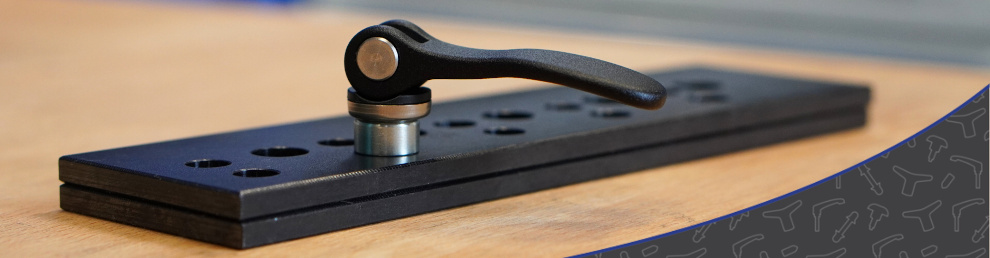
Franz Mayr, Key Account Manager at KIPP, therefore combined a standard KIPP cam lever with a conventional metal frame anchor. The principle was simple: when the lever was closed, the clamping element would expand inside the hole and grip it securely; when the lever was opened, it would contract again, allowing it to be easily removed and reused.
The improvised prototype subsequently became a KIPP development project, resulting in the patented cam lever with mandrel collet, which is now used to optimize assembly processes across a wide range of industries.
How does the cam lever with mandrel collet work?
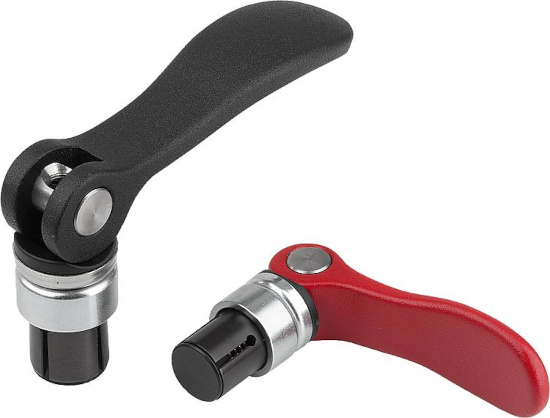
The operating principle is simple and fast. In the open position, the mandrel collet is inserted into the prepared hole in the components to be joined. Closing the cam lever expands the clamping sleeve, securely gripping the lower component.
When used in a through-hole, a pull-down effect is also generated, drawing the two components together while simultaneously centering them precisely.
An integrated disc spring assembly ensures that the cone is released from the clamping sleeve when the lever is opened. The operating diameter of the mandrel collet and the corresponding holding force can be adjusted via the tie rod using a screwdriver.
Another advantage of the design is that it can be used without particularly stringent requirements regarding dimensional tolerances or the surface quality of the hole.
Simple clamping without additional tools
The cam lever with mandrel collet makes it possible to perform several operations in a single step:
- position the components to be joined,
- center them using an existing hole,
- securely fix them together,
- pull the components together,
- quickly release and reuse the clamping element once assembly is complete.
Its reusability and quick operation make this element a practical alternative to improvised assembly fixtures or situations where an additional operator would otherwise be required to hold the components in place.
Compact design for through-holes and blind holes
KIPP uses robust materials suitable for industrial applications. The cam lever handle is made of cast aluminum, while the mandrel collet, tie rod and washers are made of steel. The thrust washer is made of fiberglass-reinforced plastic.
Thanks to its compact design, the cam lever with mandrel collet can be used in both through-holes and blind holes, with or without internal threads.
A practical solution for more efficient assembly
The story behind the development of the cam lever with mandrel collet illustrates KIPP's approach to developing new standardized components. The starting point is a specific problem encountered in industrial practice. If the solution offers broader benefits, an original customer requirement can evolve into a standard series-production product.
In this case, a simple assembly aid evolved into a versatile component for rapid positioning, centering and temporary clamping of components, helping to simplify assembly processes while reducing both the time and manpower required.
Related products
≪ Southco introduces the A4 stainless steel push-to-close latchŠkolení týmu MAREK Industrial ve společnosti Schmalz >